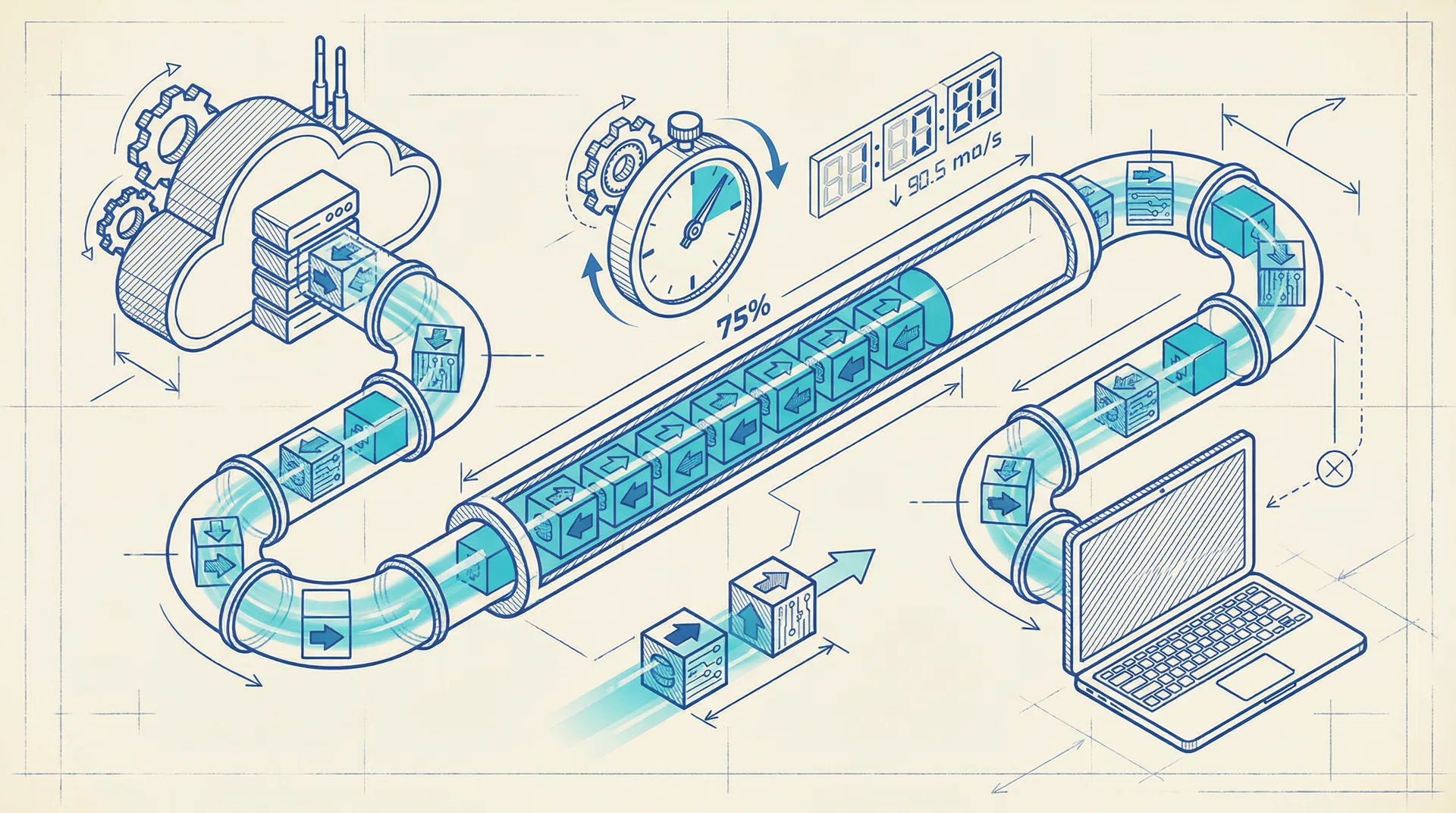
Download Time Calculator
Calculate how long a file will take to download or upload
Estimated Download Time
1m 20s
1 minute, 20.0 seconds
Quick Reference: Common File Sizes
| File Type | Size | @ 100 Mbps |
|---|---|---|
| Email attachment | 5 MB | 400 ms |
| MP3 song | 8 MB | 640 ms |
| HD photo | 25 MB | 2.0 seconds |
| HD movie (720p) | 1.5 GB | 2m |
| 4K movie | 15 GB | 20m |
| Game download | 80 GB | 1h 46m 40s |
| OS image (Windows) | 5.5 GB | 7m 20s |
How Download Time is Calculated
The download time formula is straightforward: Time = File Size / Transfer Speed. However, the tricky part is ensuring both values use the same unit system (bits or bytes).
Since internet speeds are typically measured in bits per second (Mbps) and file sizes in bytes (MB, GB), you need to convert between the two. Remember: 1 byte = 8 bits.
The Formula
Time (seconds) = File Size (bits) / Speed (bits per second)
Example: 1 GB file at 100 Mbps
= (1 × 8,000,000,000 bits) / (100,000,000 bits/sec)
= 80 seconds ≈ 1 minute 20 seconds
Factors That Affect Real Download Times
- Network congestion — Shared bandwidth with other users on your network and ISP.
- Server speed — The source server may have bandwidth limits or be under heavy load.
- Protocol overhead — TCP/IP headers add about 3-5% overhead to data transfers.
- Wi-Fi vs Ethernet — Wi-Fi connections are typically slower and less stable than wired connections.
- Distance to server — Greater physical distance increases latency and can reduce throughput.
Frequently Asked Questions
Why does my actual download take longer than calculated?
The calculator shows the theoretical minimum time at sustained maximum speed. Real downloads are affected by server speed limits, network congestion, protocol overhead (TCP/IP headers), Wi-Fi interference, and other users sharing your connection. Expect real downloads to take 10-50% longer than the theoretical time.
Should I use Mbps or MB/s for my speed?
Use whatever unit your speed test or ISP provides. Most ISPs and speed tests report in Mbps (megabits per second). If your download manager shows speed in MB/s (megabytes per second), select that unit instead. The calculator handles the conversion automatically.
How can I speed up my downloads?
Use a wired Ethernet connection instead of Wi-Fi, close other applications using bandwidth, download during off-peak hours, use a download manager that supports multiple connections, and ensure your router firmware is up to date. For large files, consider using a download accelerator or torrent client.
Does upload speed affect download time?
Generally no — download time depends on your download speed. However, your upload speed is used when uploading files, video calling, or streaming. Some protocols require acknowledgment packets to be sent back, so extremely slow upload speeds could slightly affect download performance.